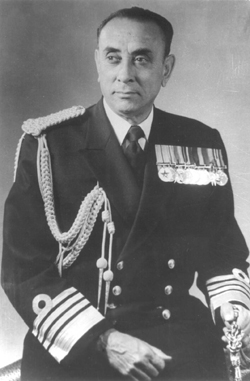
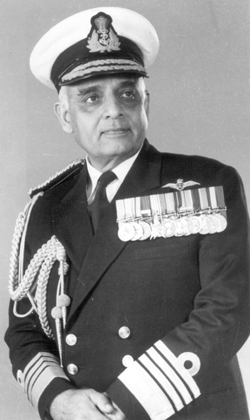
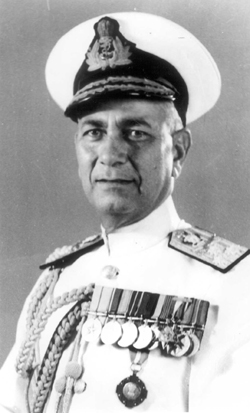
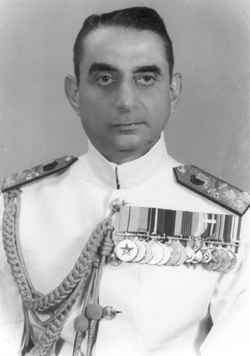
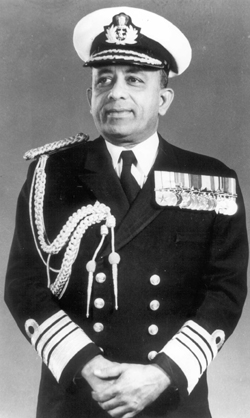
Admiral Sureesh Mehta, PVSM, AVSM, ADC Chief of the Naval Staff & Chairman, Chiefs of Staff Committee Admiral Sureesh Mehta assumed charge of the Indian Navy, as the 19th Chief of Naval Staff, on 31 October 2006. Born on 18 August 1947, he is the first service chief from the armed forces to be born post Indian Independence. He is an alumnus of the National Defence Academy (NDA) and was commissioned into the Executive Branch of the Indian Navy in July 1967. Shortly thereafter, he joined the Indian Naval Air Arm and extensively flew the Hawker Sea Hawk from the aircraft carrier Vikrant. He is a graduate of the prestigious Defence Services Staff College (DSSC) at Wellington and has also carried out instructional duties as a directing staff in that institute. He also attended the National Defence College (NDC) at New Delhi in 1994. His most distinguishing ship appointments include the command of INS Beas - a Leopard Class frigate and the first indigenously-built, guided-missile frigate of the Indian Navy - INS Godavari.
On promotion to Rear Admiral in 1995, Admiral Mehta was appointed as the Flag Officer Naval Aviation (FONA), where he was responsible for marshalling the resources of the entire aviation fleet of the Indian Navy. In October 1998, he was appointed as Flag Officer Commanding Western Fleet, a post he held with distinction till April 2000. It was during his tenure as FOC Western Fleet, that the incident of piracy aboard the MV Alondra Rainbow occurred in November 1999. This Japanese tanker was stopped by naval units under his command and the pirates were brought to book by his flagship, INS Delhi. He has also had the distinction of commanding INS Garuda, the Indian Navy's premier naval air station in Kochi, Kerala. During Admiral Mehta's tenure as Assistant Controller of Warship Production & Acquisition and Assistant Controller Carrier Projects at Naval Headquarters, he initiated wide ranging initiatives to revitalize the naval fleet and was responsible for commencement of a host of important and critical ship & aircraft acquisition programs, in preparation for blue water operations of the Indian Navy in the 21st century. In his further appointments as the Assistant Chief of Personnel (Human Resources Development), Controller Personnel Services and Chief of Personnel at Naval HQ, he was responsible for the entire Personnel Management Policy of the Indian Navy. Admiral Mehta was appointed as Director General (DG) Coast Guard on 13 January 2003 and he guided the force with the vision of establishing a strong, vibrant and visible Indian Coast Guard. He established linkages with India's maritime neighbours - both near and afar - and created common operating doctrines for tackling incidents at sea. He pursued a vigorous growth for the Coast Guard fleet and organisation, aided by active modernization programs. On the issue of piracy at sea, he has tailored Coast Guard operations towards adopting a pro-active approach in combating piracy in Indian and neighbouring waters. Prior to taking charge as CNS, Admiral Mehta served as the Flag Officer Commanding-in-Chief (FOC-in-C) of the Eastern Naval Command from 30 September 2005. It was during his tenure at the ENC, that the first-ever Presidential naval fleet review was held on the country's east coast, which saw participation by over 66 warships and 50 aircraft of the Indian Navy. He also held the office of Deputy Chief of Naval Staff (DCNS) from 2004 to 2005. He was awarded the Ati Vishist Seva Medal (AVSM) in 1995 and the Param Vishist Seva Medal (PVSM) in 2005 for exceptional meritorious services. Admiral Mehta and Mrs Maria Teresa Mehta have two children. He was appointed as the Chairman Chiefs of Staff Committee (COSC) on 28 September 2007.
Admiral Arun Prakash PVSM, AVSM, VrC, VSM, ADC CNS, 31 July 2004 - 31 Oct 2006
Admiral Arun Prakash assumed charge of the Indian Navy, as the 18th Chief of Naval Staff, on 31 July 2004. He was born in Anantnag, in the Kashmir valley, in October 1944. His father served in the Kashmir Civil Service, retiring as the District Commissioner of Leh, and young Arun's early childhood was spent in various towns of the Valley as well as Jammu and Ladakh districts. Although his two elder brothers served in the Indian Army, he was struck by sea fever from an early age and joined the National Defence Academy (NDA) as a Naval Cadet in 1961. He was formally commissioned into the Executive Branch of the Indian Navy on 01 January 1966. Admiral Prakash specialized in aviation, and qualified as an aircraft carrier pilot on the Sea Hawk jet fighter from the deck of INS Vikrant in 1968. His aviation tenures include service in a number of Indian Naval Air Squadrons, namely INAS 550 Flying Fish, INAS 551 Phantoms and INAS 300 White Tigers. In 1976, when the maritime reconnaissance role came to the Indian Navy, he converted to, and briefly flew the four-engined Super Constellation with the INAS 312 Albatross unit. He has commanded two Air Squadrons, and the Naval Air Station INS Hansa. While in command of INAS 300, he supervised the conversion and operational training of the crew on the Sea Harrier VSTOL fighter in 1983, and ferried the aircraft back to India from the United Kingdom. He has flown 2500 hours on a variety of single and multi-engined aircraft from the aircraft carrier and ashore.
Read more...
Admiral Madhvendra Singh PVSM, AVSM, ADC CNS, 29 Dec 2001 - 31 July 2004
Admiral Madhvendra Singh assumed charge of the Indian Navy, as the 17th Chief of Naval Staff, on 29 December 2001. His father, the late Major General K. Bhagwati Singh (retd.), was the first batch of Indian Cadets to pass out of the Indian Military Academy - along with Field Marshal SHFJ Manekshaw. The late Major General K.B. Singh (retd.) has the distinction of having Indian Commission Number One. After completing his schooling at the St. Xavier High School in Jaipur (Rajasthan), Madhvendra joined the National Defence Academy (NDA) at Khadakvasla in July 1958 and was commissioned into the Indian Navy on 01 January 1963. As a Cadet on board INS Krishna, he was awarded the Binocular for standing first in the overall Order of Merit and the Telescope for being the Best All Round Cadet. Later he was also awarded the coveted Sword of Honour on being adjudged the best all round Midshipman of the Fleet. Admiral Singh specialised in Gunnery and has also undergone the Advanced Gunnery Course at the Royal Military College of Science at Shrivenham, United Kingdom. He is a Graduate of the Defence Services Staff College (DSSC), Wellington and a post-graduate of the Naval War College at Newport, USA and the National Defence College in New Delhi. He has commanded the aircraft carrier INS Viraat; the guided-missile destroyer INS Ranvir; the guided-missile frigate INS Talwar and the Naval Academy at Kochi.
Read more...
Admiral Sushil Kumar PVSM, UYSM, AVSM, NM, ADC CNS, 30 Dec 1998 - 29 Dec 2001
Admiral Sushil Kumar assumed charge of the Indian Navy, as the 16th Chief of Naval Staff, on 30 December 1998. A specialist in hydrography and amphibious warfare, he is also a qualified air warfare instructor. He has participated in the 1961 Goa Liberation and in both the Indo-Pak Wars of 1965 and 1971. As Director of Naval Operations, he was decorated with an Uttam Yudh Seva Medal for his exceptional conduct in Operation Pawan (Sri Lankan Operations) and in Operation Cactus (Liberation of Maldives. He was awarded the Naosena Medal (NM) for gallantry whilst in command of INS Ghorpad. He is an alumni of the National Defence College and was an instructor at the Defence Services Staff College, Wellington. His training abroad includes a deputation to the Royal Navy onboard HMS Dampier in 1963 and a course in amphibious warfare with the US Navy at Coronado, San Diego, in 1976. Admiral Kumar has held operational commands and important posts such as the Vice Chief of Naval Staff, the Flag Officer Maharashtra Area, Commander of the Flotilla in Mumbai and Fortress Commander Andaman & Nicobar Islands. He was the Flag Officer Commanding-in-Chief of the Southern Naval Command in Kochi, before being appointed as the Chief of Naval Staff. During his tenure as CNS, Admiral Kumar was the highest-decorated 'serving' officer in the Indian Navy and upon his retirement on 29 December 2001, he completed 40+ years of distinguished service. He is a keen yachtsman and has the rare distinction as a Naval Officer to have played polo on the international circuit with an international rating of 4+ goals.
Admiral Vishnu Baghwat PVSM, AVSM, ADC CNS, 30 Sep 1996 - 30 Dec 1998
Admiral Vishnu Baghwat assumed charge of the Indian Navy, as the 15th Chief of Naval Staff, on 30 September 1996. Commissioned into the Indian Navy on 01 January 1960, he is a graduate of the National Defence Academy (NDA). He was awarded the Telescope for the Best All-Round Cadet on the training vessel, INS Tir and the Sword of Honour for the Best All-Round Midshipman of the Fleet. In his 36 years of distinguished service, Admiral Bhagwat has had a vast and varied experience in combat operations, warship production, acquisition & acceptance, personnel management and command. He was actively associated with the 1961 Goa operations, and during the 1971 Indo-Pak conflict, his ship was in the escort groups for missile boats responsible for humbling the adversary. A specialist in Communication & Electronic Warfare, he was the Flag Lieutenant to the CNS from 1968-70 and the Naval Assistant to the CNS from 1986-87. Admiral Bhagwat completed his first major command in INS Amini with the Western Fleet, before being assigned as the Fleet Operations Officer of the same fleet, from 1978-79. He commissioned INS Ranjit in November 1983 and was in command of the vessel for 2½ years during which the ship set new fleet standards/records in weapons, sensors and operations. On promotion to the Flag rank in 1988, he served as the Additional Director General Defence Planning Staff, Chief of Staff of Western Naval Command and as the Flag Officer Commanding Eastern Fleet.
Read more...
Admiral V S Shekhawat PVSM, AVSM, VrC, ADC CNS, 30 Sep 1993 - 30 Sep 1996
Admiral Vijai Singh Shekhawat assumed charge of the Indian Navy, as the 14th Chief of Naval Staff, on 30 September 1993. Having grown up in a military environment, he spent his childhood years in various cantonments including Peshawar (Pakistan) and Dhaka (Bangladesh) in the then undivided India. His father, a paratrooper, was amongst the first officers to be commissioned from the Indian Military Academy (IMA). Passing through several schools as the family moved on transfers, his main education was in Colonel Brown's School and St. Joseph's Academy in Dehradun, Bishop Cotton Boys' School in Bangalore and St Joseph's College in North Point, Darjeeling. His interest in the sea developed early from reading stories of sailing ships, pirates and far off islands, and joining the navy was almost a foregone conclusion. He was selected for the 7th Course of the Joint Services Wing, National Defence Academy, then at Clement Town, Dehradun in January 1952. He was first in overall order of merit and awarded the President's Gold Medal for the best all-round cadet on passing out in December 1953. During his Academy days, he was an outstanding sportsman and was awarded Blues in Athletics, Boxing, Football, Swimming and Riding. His early riding experience with the Mysore and the Gwalior Lancers stood him in good stead and he won the first prize in Cadet's Show Jumping at the first post-war Army Horse Show held in New Delhi in 1954. He was a member of the academy debating teams participation in inter-university debates, notably against Oxford University, and also a prominent member of the Dramatics.
Read more...
Admiral Laxminarayan Ramdas PVSM, AVSM, VrC, VSM, ADC CNS, 30 Nov 1990 - 30 Sep 1993
Admiral Laxminarayan Ramdas assumed charge of the Indian Navy, as the 13th Chief of Naval Staff (CNS), on 30 November 1990. Born on 05 September 1933, he was commissioned into the Indian Navy on 01 September 1953 after training at the Royal Naval College in Dartmouth, England. A Communication Specialist, Admiral Ramdas underwent Royal Naval Staff College at England and as a Commander he established and commanded the Naval Academy at Cochin where he distinguished himself for which he was awarded Vishisht Seva Medal (VSM). During the 1971 Indo-Pak Operations, whilst in command of INS Beas, Admiral Ramdas took part in the most effective naval blockade of East Pakistan (Bangladesh) which frustrated Pakistan's attempt to evacuate 91,000 of their troops who eventually surrendered to the Indian Forces. INS Beas also captured a large number of ships carrying contraband to East Pakistan, bombarded Cox Bazar and took part in the landing and other operations in an area infested with mines and submarines. For his resolute, bold, gallant and imaginative action in the face of great danger, he was decorated with the Vir Chakra. He later commanded a Patrol Vessel Squadron in the Indian Navy. Admiral Ramdas served as Naval Attaché in Germany for three years. He held the appointments of Director of Personnel, Director of Naval Signals and Director of Naval Operations at the Naval HQ. Other notable appointments he held were Assistant Chief of Naval Staff (Operations), Flag Officer Commanding Eastern Fleet, Controller of Warship Production & Acquisition, Deputy Chief of Naval Staff (DNCS) and Flag Officer Commanding-in-Chief of the Southern Naval Command. Prior to taking over as Chief of the Naval Staff, Admiral Ramdas was the Flag Officer Commanding-in-Chief of the Eastern Naval Command which he held since February 1989. A distinguished sportsman, an enthusiast of sailing and adventure activities, he promoted sports and adventure activities in the Navy to a great extent. He is a recipient of Param Vishist Seva Medal (PVSM) and the Ati Vishist Seva Medal (AVSM) in addition to the Vir Chakra (VrC) and the Vishist Seva Medal (VSM). Married to Lalita Ramdas since 19 October 1961, he has three daughters and three grandchildren. His interests include history, golf, cricket and yachting.
Admiral J G Nadkarni PVSM, AVSM, NM, VSM, ADC CNS, 30 Nov 1987 - 30 Nov 1990
Admiral Jayant Ganpat Nadkarni assumed charge of the Indian Navy, as the 12th Chief of Naval Staff, on 30 November 1987. Born in Bombay on 05 December 1931, he did his early schooling in the city and joined the Indian Mercantile Marine Training Ship DUFFERIN in 1946. On completion of three years' of training on board the DUFFERIN, Admiral Nadkarni graduated with distinction in December 1948. He then joined the Royal Indian Navy (RIN) in March 1949 and proceeded to the United Kingdom for his initial training. He received training there, from 1949-53, during which he served on aircraft carriers and destroyers. Admiral Nadkarni subsequently returned to India as the commissioning crew of the Hunt Class destroyer, INS Ganga. Subsequently, he specialised in Navigation and Direction and was the Navigating Officer of the cruiser, INS Delhi for over four years. He has also held command of INS Talwar and INS Delhi. In the latter appointment, he was also the Senior Officer, First Training Squadron. His important shore appointments include Chief Instructor at Defence Services Staff College, Chief of Staff of the Western Naval Command and the Senior Directing Staff at National Defence College, New Delhi. Promoted to the rank of Rear Admiral in December 1980, he commanded the Western Fleet from May 1981 to August 1982. Promoted to the rank of Vice Admiral in August 1982, he held the post of Chief of Personnel at Naval HQ until April 1984. He was then appointed as the Flag Officer Commanding-in-Chief of the Eastern Naval Command and became the Vice Chief of Naval Staff at Naval HQ in February 1986.
Read more...
Admiral R H Tahiliani, PVSM, AVSM CNS, 30 Nov 1984 - 30 Nov 1987
Admiral Radhakrishna Hariram Tahiliani assumed charge of the Indian Navy, as the 11th Chief of Naval Staff, on 30 November 1984. Born on 12 May 1930, he was commissioned into the Indian Navy's naval aviation branch on 01 September 1950. A qualified test pilot, his major commands at sea include INS Trishul and aircraft carrier, INS Vikrant. On elevation to the rank of Rear Admiral in December 1977, Admiral Tahiliani assumed charge of Flag Officer Goa Area and later as Flag Officer Commanding Western Fleet (FOCWF). Subsequently, he served in Naval HQ as Assistant Chief of Naval Staff (ACNS) and Deputy Chief of Naval Staff (DCNS) and was the first incumbent when the latter post was elevated to that of a Vice Admiral. In February 1982, Admiral Tahiliani was appointed as the Flag Officer Commanding-in-Chief of Southern Naval Command. In March 1983, he was appointed as the Flag Officer Commanding-in-Chief of Western Naval Command and served in this capacity for a year, till he was appointed as the Vice Chief of Naval Staff (VCNS) in May 1984. Admiral Tahiliani has the rare distinction of having been the Flag Officer Commanding-in-Chief of two Naval Commands. He is a graduate of the Naval War College, USA and the National Defence College, New Delhi. He is a recipient of the Param Vashisht Seva Medal (PVSM) and Ati Vishisht Seva Medal (AVSM) for his distinguished service. He retired on 30 November 1987, after completing nearly 37 years of service.
Admiral O S Dawson, PVSM, AVSM, ADC CNS, 28 Feb 1982 - 30 Nov 1984
Admiral Oscar Stanley Dawson assumed charge of the Indian Navy, as the 10th Chief of Naval Staff, on 28 February 1982. Born in Burma, he also had his high school education there. When the Japanese occupied Burma in March 1942, he shifted to India where he continued his studies. Commissioned in the Royal Indian Naval Volunteer Reserve (RINVR) on 07 January 1943, Admiral Dawson was subsequently thereafter absorbed in the regular cadre of the Royal Indian Navy (RIN). Even as a junior officer his career was marked with distinction and the sea has always been his first love. He participated in World War II in the Arakan Operations (Burma), on convoy escort duty in the Bay of Bengal and the Arabian Sea and in mine-sweeping operations soon after the war. Trained as a specialist in Navigation & Direction in the United Kingdom, Admiral Dawson has held various afloat and ashore appointments. He served as the Naval ADC to President Dr. Rajendra Prasad, from 1953-54 and since 02 March 1981 is the Honorary Naval ADC to the President. Subsequent to his graduation from the Defence Services Staff College in 1957, Admiral Dawson served as the navigating officer of the aircraft carrier, INS Vikrant and also as the Fleet Navigating Officer. Later, he held appointments of Officer-in-Charge, Navigation & Direction School and that of the Director, Tactical School and Chief Staff Officer at Cochin.
Read more...
Admiral R L Pereira, PVSM, AVSM CNS, 28 Feb 1979 - 28 Feb 1982
Admiral Ronald Lynsdale Pereira assumed charge of the Indian Navy, as the 9th Chief of Naval Staff, on 28 February 1979. Born on 25 May 1923, he was commissioned into the Indian Navy on 25 May 1943. During World War II, he saw active service aboard gunboats in Burma and Malaysia between 1943-45 and thereafter, continued at sea with an amphibious task group based in Iraq, till 1946. After Independence in 1947, Admiral Pereira served for several years as a Gunnery Specialist, both afloat and ashore, before taking over as Officer-in-Charge of the Gunnery School, Cochin in 1956. A graduate of the Defence Services Staff College, he has served as Deputy Commandant of the National Defence Academy in Pune and as the Director of Combat Policy & Tactics at Naval HQ. He commanded the Indian Navy's Flag Ship, INS Delhi and commanded an anti-submarine warfare frigate, INS Khutar. He is considered as one the architects of the modern Indian Navy. Admiral Pereira held the appointments of Flag Officer Commanding Eastern Fleet (FOCEF), Flag Officer Commanding of the Southern Naval Command and the Flag Officer Commanding-in-Chief of the Western Naval Command. In 1971 he was awarded the Ati Vishisht Seva Medal (AVSM) and in 1977 was awarded the Param Vishisht Seva Medal (PVSM). He is a keen sportsman having represented the Indian Navy in Hockey in 1946 and in Golf in the 1960s.
Admiral Jal Cursetji, PVSM CNS, 29 Feb 1976 - 28 Feb 1979
Admiral Jal Cursetji assumed charge of the Indian Navy, as the 8th Chief of Naval Staff, on 28 February 1976. Born on 20 May 1919, he joined the Royal Indian Navy as a cadet in January 1938 and was commissioned in September 1940. He served on board various naval ships during the war and was in command of INS Bombay in 1944. Specialising in hydrography, Admiral Cursetji commanded naval survey ships for a number of years. He was the Surveyor-in-Charge, Marine Survey of India from 1950-54 and in 1955, he became the first Indian Chief Hydrographer to the Government, an appointment he held for more than two years. Admiral Cursetji's other important appointments were Naval Attaché in Washington and commanding aircraft carrier, INS Vikrant. Promoted to the rank of Rear Admiral, in December 1967, he took over as the Chief of Personnel at Naval HQ. In February 1970 he was appointed as the Vice Chief of the Naval Staff (VCNS) in the rank of Vice Admiral.
Read more...
Admiral S N Kohli Padma Bhushan, PVSM CNS, 28 Feb 1973 - 29 Feb 1976
Admiral Sourendra Nath Kohli assumed charge of the Indian Navy, as the 7th Chief of Naval Staff, on 28 February 1973. Prior to this appointment, he was was the Flag Officer Commanding-in-Chief of the Western Naval Command, the largest command in the Indian Navy. Born on 21 June 1916, Admiral Kohli was educated at St. Stephen’s College, Delhi. He then joined the Royal Indian Navy as a cadet in May 1936 and proceeded to the United Kingdom for training. Two years later he was commissioned as a Sub Lieutenant into the Royal Indian Navy on 25 June 1938. He qualified as a Communication Specialist in the United Kingdom in 1943. During the Second World War, Admiral Kohli saw action in the Persian Gulf and also in the Far Eastern theatre. After Independence, Admiral Kohli was one of those specially chosen to head the expanding Indian fleet. He was deputed to the United Kingdom in December 1948 in connection with acquisition of destroyers and was appointed as the Commanding Officer of INS Rana, an Admiralty Class destroyer, when the ship was taken over from Royal Navy. Among the important appointments held by him since then are the senior officer of INS Godavari, a Hunt Class escort frigate and later the Commanding Officer of INS Mysore, a Crown Colony/Fiji Class cruiser.
Read more...
Admiral S M Nanda, PVSM, AVSM CNS, 28 Feb 1970 - 28 Feb 1973
Admiral Sardari Mathradas Nanda assumed charge of the Indian Navy, as the 6th Chief of Naval Staff, on 28 February 1970. Born in 1915, he joined the Royal Indian Naval Volunteer Reserve in October 1941. Prior to his joining the RINVR, he had served with Port Trust in Karachi. Since Independence in 1947, Admiral Nanda held a number of important appointments both ashore and afloat that gave him varied experience. In 1948, he joined the Navy's first cruiser INS Delhi in the United Kingdom as her First Lieutenant. On his return to India, he served as the Director of Personnel Services at Naval HQ from 1949-51. He later commanded the destroyer, INS Ranjit, as well as a Frigate Squadron. Posted back to Naval HQ, he became the Chief of Personnel and was promoted to the rank of Commodore. In 1957, Admiral Nanda commissioned the cruiser INS Mysore in the United Kingdom. Subsequently, he was appointed Director General, Naval Dockyard Expansion Scheme, at Bombay. He was awarded the Ati Vishisht Seva Medal (AVSM) in 1961. There after, he underwent a course at the Imperial Defence College in London, returning to Naval HQ to assume the appointment of Chief of Material.
Read more...
Admiral A K Chatterji CNS, 03 Mar 1966 - 28 Feb 1970
Admiral Adhar Kumar Chatterji assumed charge of the Indian Navy, as the 5th Chief of Naval Staff, on 03 March 1966. Born in 1914, he entered the Royal Indian Navy in 1933 as one of the first cadet-entry officers. He qualified as an anti-submarine specialist in the United Kingdom in 1940, and subsequently saw active service afloat in the Second World War in the Atlantic and Indian Ocean areas in various ships of the Royal and Royal Indian Navies. In August 1947, Admiral Chatterji completed his staff course in the United Kingdom and on his return to India, was appointed Director of Naval Plans in Naval HQ. In June 1950, he assumed command of the flagship of the Indian fleet, INS Delhi (the erstwhile HMS Achilles of the Battle of River Plate Fame), in the rank of Captain. He was the first Indian officer to command the cruiser, in which he took part in a number of combined exercises and paid good-will visits to several countries in the Far East and the Mediterranean.
Read more...
Vice Admiral B S Soman CNS, 04 Jun 1962 - 03 Mar 1966
Vice Admiral Bhaskar Sadashiv Soman assumed charge of the Indian Navy, as the 4th Chief of Naval Staff, on 04 June 1962. Born in March 1913, at Gwalior, he was selected for the Royal Indian Marine in 1931. After his initial training in the United Kingdom, he returned to India as a Sub Lieutenant in August 1934. During World War II, he served as First Lieutenant and for a time, as the Commanding Officer of HMIS Cornwallis in the Red Sea and the Persian Gulf in 1939 and 1940 respectively. He took part in capturing the Italian Submarine Gallilio off Aden, Yemen. Later he commissioned HMIS Khyber, a fleet mine-sweeper of the Royal Indian Navy. He was the Senior Instructor in combined operations training establishments at Mandapam, Tamil Nadu and Hamla near Bombay. He was one of the first Indian Officers to be promoted to the rank of Acting Captain in June 1947. During the months following Partition in 1947, he was the first Indian to be appointed to the key post of Chief of Personnel at Naval HQ. In October 1949, he went to sea in command of INS Jumna. He carried a number of goodwill visits to some of our neighbouring countries in the Persian Gulf, Malaya and East Africa.
Read more...
Vice Admiral R D Katari CNS, 22 Apr 1958 - 04 June 1962
Vice Admiral Ram Dass Katari assumed charge of the Indian Navy, as the 3rd Chief of Naval Staff, on 22 April 1958. The first Indian Chief of the Naval Staff and the first Indian to become an Admiral in Indian Navy, he has the proud distinction of holding many other 'firsts' in academic and professional careers. The senior-most Indian Officer of the Navy, Vice Admiral Katari was born in Chinglenut (near Madras) and spent his childhood and youth in Hyderabad. After completion of his school and college studies he joined the Training Ship Dufferin and stood first in the entrance examination. Vice Admiral Katari has the unique triple distinction of being the first cadet to join the Training Ship Dufferin, when this institution was founded in 1927, to be first winner of the Viceroy's Gold Medal and to become the first Member representative Ex-Cadets on the Governing Body of the Dufferin. During World War II, he was active in service in the Atlantic and Indian Oceans and held a variety of appointments both afloat and ashore. Having specialized in anti-submarine warfare, he was for a while instructor in the Anti-Submarine School.
Read more...
Vice Admiral Sir S H Carlill, BE, CB, DSOCNS, 21 Jul 1955 - 21 Apr 1958 UNDER CONSTRUCTION

Admiral Sir Mark Pizey, BE, CB, DSO C-in-C, 13 Oct 1951 - 31 Mar 1955 CNS, 01 Apr 1955 - 21 Jul 1955 UNDER CONSTRUCTION
Admiral Sir William Edward Parry, KCB C-in-C, 14 Aug 1948 - 13 Oct 1951
UNDER CONSTRUCTION
Rear Admiral John Talbot Savignac Hall, CIE C-in-C, 15 Aug 1947 - 14 Aug 1948
UNDER CONSTRUCTION
|
|